Showing posts with label Poland. Show all posts
Showing posts with label Poland. Show all posts
Tuesday, March 16, 2021
Sabaudia youtube
Anthony Raczkiewicz (my grandfather) and his siblings were born in Sabaudia, near the city of Tomaszów Lubelski. This video will give you a glimpse of the village:
“The very name of the village of Sabaudia reminds us exceptionally European. No wonder, because apart from Poles, it was also founded by foreigners, five Germans and a Dane. Until today, some residents have retained foreign-sounding surnames and remember their ancestors who came to this area in 1840 looking for their place.
Today's inhabitants praise their town very much. They have good access to the city, beautiful views and a school. The Tomaszów Lubelski commune has made many investments for them: a new road or lighting are just two of many examples of investments, which often use European Union funds. It is also thanks to them that the Polish countryside develops, becomes more friendly to its inhabitants and more attractive to tourists and new settlers.
While traveling through the Tomaszów Lubelski Commune, we will visit every town in this commune. We will show people who create it, the traditions that are cultivated there, monuments worth visiting and the quiet, idyllic life of the inhabitants of this wonderful region.”
https://www.youtube.com/watch?v=zgJ50bNX5rw

Laszczow Used to Have Many Jewish Inhabitants
 My Mother’s DNA included 4% Jewish which means it could be anywhere between 1 and 6%. If there is a relative or more that was Jewish, I have not yet found that out. Because Laszczow had such a large population of people who were Jewish, I wondered if there was any connection. There is a list of over a hundred Jewish households from this time period that lived in Laszczow and I do not recognize any of the names as surnames in our family. . http://chelm.freeyellow.com/laszczow.html -----------------------------
Laszczow had a large Jewish community, They made a living in trade of grain and craft and lived in the Market Square. There was a Jewish printing house. The Jewish population increased over the 19th century from 826 people in 1827 to 1,621 ipeople n 1897. At that point, Jews were over 90% of the population. In the 20th century, Laszcow was mainly Jewish.
The area suffered many times from attacks from various sources. A Jewish surgeon, Alfrons Brawstedt opened a 30 bed hospital that treated men wounded in the November Uprising (1830-1831.) In 1920, the Russians attacked the town, harming and killing many people. Many fled and those that remained lived in poverty. In 1939 the Nazis occupied the town and over the next several years sent the inhabitants to slave labor and death camps. Few survived. On Christmas Eve, 1942, 75 Poles were murdered in retaliation for an earlier confrontation between several villagers and four armed German police officers. In 1944 the Ukranian Insurgent Army burnt down the village.
--------------------------------------------
http://iajgscemetery.org/eastern-europe/poland/laszczow https://sztetl.org.pl/en/towns/l/713-laszczow/99-history/137619-history-of-community
Image: Tomasz Zugaj, CC BY-SA 4.0
My Mother’s DNA included 4% Jewish which means it could be anywhere between 1 and 6%. If there is a relative or more that was Jewish, I have not yet found that out. Because Laszczow had such a large population of people who were Jewish, I wondered if there was any connection. There is a list of over a hundred Jewish households from this time period that lived in Laszczow and I do not recognize any of the names as surnames in our family. . http://chelm.freeyellow.com/laszczow.html -----------------------------
Laszczow had a large Jewish community, They made a living in trade of grain and craft and lived in the Market Square. There was a Jewish printing house. The Jewish population increased over the 19th century from 826 people in 1827 to 1,621 ipeople n 1897. At that point, Jews were over 90% of the population. In the 20th century, Laszcow was mainly Jewish.
The area suffered many times from attacks from various sources. A Jewish surgeon, Alfrons Brawstedt opened a 30 bed hospital that treated men wounded in the November Uprising (1830-1831.) In 1920, the Russians attacked the town, harming and killing many people. Many fled and those that remained lived in poverty. In 1939 the Nazis occupied the town and over the next several years sent the inhabitants to slave labor and death camps. Few survived. On Christmas Eve, 1942, 75 Poles were murdered in retaliation for an earlier confrontation between several villagers and four armed German police officers. In 1944 the Ukranian Insurgent Army burnt down the village.
--------------------------------------------
http://iajgscemetery.org/eastern-europe/poland/laszczow https://sztetl.org.pl/en/towns/l/713-laszczow/99-history/137619-history-of-community
Image: Tomasz Zugaj, CC BY-SA 4.0 Saturday, March 13, 2021
US Time Change is March 14; Poland is 28 March

Sunday, March 7, 2021
Battle of Tomaszów Lubelski
This video shows the beginning of the conflict that resulted in Franciszek Raczkiewicz’s (my great uncle) death four years later. It is about the Battle of Tomaszów Lubelski which occurred 18 September to 20 September 1939. According to the Youtube post, it was the second largest battle of the Invasion of Poland and also the largest tank battle of the campaign. It resulted in the surrender of Army Krawko on 20 September 1939.
https://www.youtube.com/watch?v=LCejwWM2N1E (link is active on the Facebook page)
Friday, March 5, 2021
Looking Back at World War II

Thursday, March 4, 2021
Where are you from?

Tuesday, March 2, 2021
March
Check out the Facebook page Kids in the City to find out about Poland in March.
https://www.facebook.com/kidsinthecity.poland
Sunday, February 28, 2021
Tomaszów Lubelski Youtube Video

Saturday, February 20, 2021
House Numbers: Wisniowski (Tomaszow Lubelski)
Blazej Wisniowski and Jagnieska nee Szczesnicka (my 4x great grandparents) may have moved around a bit. Blazej is referred to as “famous” in the middle of the time period captured -- 1813 to 1818 -- I am not sure if that is due to his work in pottery or to differentiate him from a Blazej who was in the “poor house.” Blazej Wisniowski and single mother Anna Paszkoska had a child Francis in 1814 when he lived in the poor house and she worked there. This was located at #27. This is a different Blazej
My 4x great grandparents had various house numbers in the records for the time period of 1813 to 1817. (349, 360, 36, 36, 339, 339, 276) The Blazej that is my 4x great grand parent and his wife Jagnieska had their son Wojcieh in 1813, #349. In 1815, Blazej Wisniowski and Jagnieska nee Szczesnicka had Jozef in their house #360. A year later Jozef dies and the house is recorded as #36. Anna is born the the “famous” Blazaz in 1817 in his house #339. Anna died the following year (1817) in their house #339. In 1818, they had another child named Anna and she was born in #276. The Wisniowski family was potters. The other family of potters--the Wiciejewski family-- lived in the area of 206 and 207.
Tuesday, February 16, 2021
Fat Tuesday and Paczki

Thursday, February 11, 2021
Today is Fat Thursday.
 Today is Fat Thursday. Have you had a paczki today? What is your favorite flavor?*******************
CZmarlin — Christopher Ziemnowicz, releases all rights but a photo credit would be appreciated if this image is used anywhere other than Wikipedia. Please leave a note at Wikipedia here. Thank you!, Public domain, via Wikimedia Commons
Today is Fat Thursday. Have you had a paczki today? What is your favorite flavor?*******************
CZmarlin — Christopher Ziemnowicz, releases all rights but a photo credit would be appreciated if this image is used anywhere other than Wikipedia. Please leave a note at Wikipedia here. Thank you!, Public domain, via Wikimedia Commons
Friday, February 5, 2021
A Polish & American Hero Born on February 4
Thaddeus Kosciuszko is a Polish hero that many Americans have heard of at least those of us who grew up in cities with a large amount of Polish immigrants. Grand Rapids has a Kosciuszko Hall -- near Sacred Heart Church where my grandfather married his first wife. It is one of the many halls started in Grand Rapids to support the immigrants in different ways. Detroit has a statue of him and also of Casmir Pulaski. Right now in the United States many questions are coming up about statues and if the people commemorated are really heros. I suspect there will be no question about the Polish ones in Detroit.
Koscisuzko was born in 1746. He came to America in 1776 and used his engineering skills to help the colonies in their desire for independence. He went back to Poland and was a national hero of the 1794 insurrection.
Monday, February 1, 2021
Laszczow Used to Have Many Jewish Inhabitants
.svg) My Mother’s DNA included 4% Jewish which means it could be anywhere between 1 and 6%. If there is a relative or more that was Jewish, I have not yet found that out. There is a list of over a hundred Jewish households from this time period that lived in Laszczow and I do not recognize any of the names as surnames in our family. http://chelm.freeyellow.com/laszczow.html *****
Laszczow had a large Jewish community, They made a living in trade of grain and craft and lived in the Market Square. There was a Jewish printing house. The Jewish population increased over the 19th century from 826 people in 1827 to 1,621 ipeople n 1897. At that point, Jews were over 90% of the population. In the 20th century, Laszcow was mainly Jewish.
The area suffered many times from attacks from various sources. A Jewish surgeon, Alfrons Brawstedt opened a 30 bed hospital that treated men wounded in the November Uprising (1830-1831.) In 1920, the Russians attacked the town, harming and killing many people. Many fled and those that remained lived in poverty. In 1939 the Nazis occupied the town and over the next several years sent the inhabitants to slave labor and death camps. Few survived. On Christmas Eve, 1942, 75 Poles were murdered in retaliation for an earlier confrontation between several villagers and four armed German police officers. In 1944 the Ukranian Insurgent Army burnt down the village. *****
Added clarification from Andrzej Dubiel: Laszczow and Laszczowka are two different places. The first one is bigger and is it 20 km. east of Tomaszow. The second one is a village near Tomaszow --about 3km away.
http://iajgscemetery.org/eastern-europe/poland/laszczow https://sztetl.org.pl/en/towns/l/713-laszczow/99-history/137619-history-of-community
https://www.historiaregionu.org/posty-autorstwa-slawomira-litkowca?lang=pl article about 1942 75 Poles killed
photo: Bible_scroll_template.svg: BáthoryPéter (talk)Star_of_David.svg: Zscout370P_blank.svg: Booyabazookaderivative work: Beao, CC BY-SA 3.0
My Mother’s DNA included 4% Jewish which means it could be anywhere between 1 and 6%. If there is a relative or more that was Jewish, I have not yet found that out. There is a list of over a hundred Jewish households from this time period that lived in Laszczow and I do not recognize any of the names as surnames in our family. http://chelm.freeyellow.com/laszczow.html *****
Laszczow had a large Jewish community, They made a living in trade of grain and craft and lived in the Market Square. There was a Jewish printing house. The Jewish population increased over the 19th century from 826 people in 1827 to 1,621 ipeople n 1897. At that point, Jews were over 90% of the population. In the 20th century, Laszcow was mainly Jewish.
The area suffered many times from attacks from various sources. A Jewish surgeon, Alfrons Brawstedt opened a 30 bed hospital that treated men wounded in the November Uprising (1830-1831.) In 1920, the Russians attacked the town, harming and killing many people. Many fled and those that remained lived in poverty. In 1939 the Nazis occupied the town and over the next several years sent the inhabitants to slave labor and death camps. Few survived. On Christmas Eve, 1942, 75 Poles were murdered in retaliation for an earlier confrontation between several villagers and four armed German police officers. In 1944 the Ukranian Insurgent Army burnt down the village. *****
Added clarification from Andrzej Dubiel: Laszczow and Laszczowka are two different places. The first one is bigger and is it 20 km. east of Tomaszow. The second one is a village near Tomaszow --about 3km away.
http://iajgscemetery.org/eastern-europe/poland/laszczow https://sztetl.org.pl/en/towns/l/713-laszczow/99-history/137619-history-of-community
https://www.historiaregionu.org/posty-autorstwa-slawomira-litkowca?lang=pl article about 1942 75 Poles killed
photo: Bible_scroll_template.svg: BáthoryPéter (talk)Star_of_David.svg: Zscout370P_blank.svg: Booyabazookaderivative work: Beao, CC BY-SA 3.0 Location: Laszczow

Laszczow: 3D Scan of a Mansion and Youtube Video
This one is 3D scans of a 16th century mansion house in Laszczow:
https://www.3deling.com/portfolio-item/laszczow/
This short video is fun to watch to see what Łaszczówka looks like. https://www.youtube.com/watch?v=iFJE-2E10fY
Without knowing Polish though, we will miss a lot that this beautiful reporter highlights. I did learn that the village has a volunteer fire department, a school, library and a football (soccer) club. The "Piekiełko" Geological Reserve is highlighted. The boulders are thought to be a place of pre-Slavic worship but it is unknown how it was made or who did it. The area is called “wilderness.” The Reserve dates from 1962 in an attempt to protect the boulders (which are made of sandstone) and are unique in the area and ramparts. Also seen is a shrine of the visitation of the Mother of God.
Check out the Facebook page for active links for these resources. https://www.facebook.com/Polish-Family-History-102520648303884
February in Poland

Friday, January 29, 2021
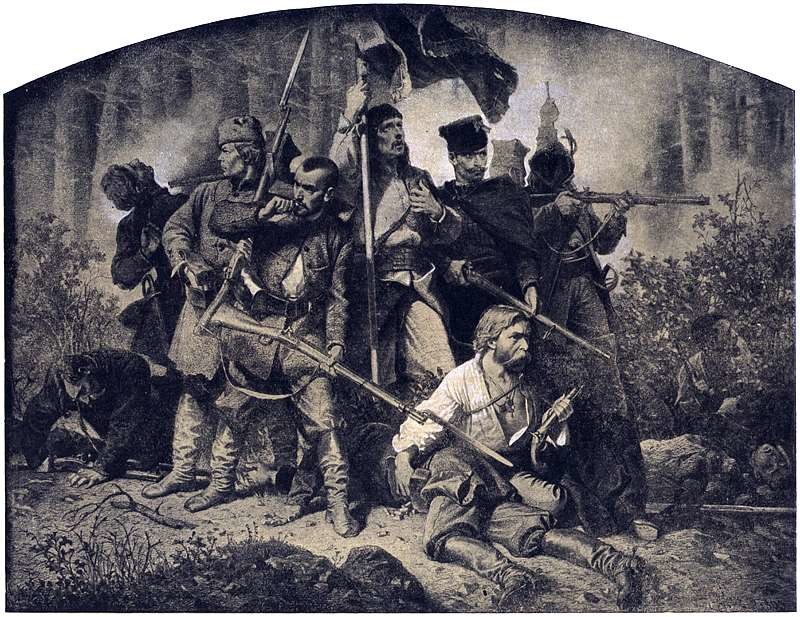
Jozef Kaszucki and the 1863 January Revolution
Wednesday, January 27, 2021
A Description of Tomaszow Lubelski A Year After My Grandfather Left

Church Pictures from Tomaszow Lubelskie


Sabaudia in the Winter

Subscribe to:
Posts (Atom)
The Story of Kazimierz Krawczyk & Rozalia Kobak
Besides the Raczkiewicz family (Pawel and Franciszka) originating from Łaszczówka, another branch of the family also originated from there...

-
 Tomorrow is the anniversary of my grandfather’s parents’ wedding. The translated record starts out, “ It happened in town Tomaszów(Tomaszó...
 -
 Most of the emigration from Poland occurred in the late 1800s to early 1900s but there was a small amount before then. The very first Po...
 -
 Tomaszów Lubelski became a city 400 years ago in 1621. It was a town founded at the end of the 16th century by Jan Zamoyski, For compar...