(image credit https://s.inyourpocket.com/gallery/228463.jpg)
**********Major events have been happening in the United States the past year. It would be interesting to see how those events are viewed in the future -- 10, 50, 100 years from now. In the same way, many major events happened in Poland during the lives of many of my ancestors. It leads me to wonder about their involvement in those events or any impact the events may have had on them. One time period I am curious about is the Fall of 1862 and the winter of 1863. My explanations are from what I have read and I am sure could be better explained by a student of history or by someone from Poland. I would love it if a relative from Poland could add any information about this event and if we had any relatives involved in it.
That time period involved rising civil unrest in Poland, including in the immediate area around Tomaszow Lubelski. Add to what was happening, normal personal family events and it makes for some possibly challenging times. This time period was personally eventful for Jozef Kaszucki. (my 2nd great grandfather.)************
Jozef Kaszucki (my 2nd great grandfather) was an adult during this period, living in the city. Of Tomaszów Lubelski. His father Andrzej had moved from Ulnow, Galicia, Austria (now Ukraine) for a better life. Andrezej had met Salomea there In Tomaszow. Her family were potters and his family were furriers for generations. Andrzej and Salomea had their son Jozef and his siblings in Tomaszow.
Jozef and his first wife Katarzyna (nee Szokalowicz) had been married for 11 years. Witnesses to their Greek Catholic marriage included Wojceich Janusz, a weaver (I think related to Patrice (Szymanski) Shay)) and Szczepan Czarnopys, a shoemaker (Mike’s second great grandfather.) Their wedding included a prenuptial agreement, prepared by a notary in the Circuit of Tomaszow. Prenups were rare at this time but used to protect a family’s property, as they are now. Jozef and Katarzyna had two children (maybe more but that is what I have so far found). Sadly, the first one Jan, passed away in 1859 at six months old. ***********
Within a short time period during the Fall of 1862, family tragedy struck several times. On October 25, four year old daughter Joanna, who had been baptised and confirmed through the rites of the Greek Catholic church, passed away. Reporting the death with him was Grzegorz Niedzwiedz (Curt’ Wolf’s relative.) A month later on November 24, Jozef’s wife Katarzyna died at age 30. This time, Marcin Halkieiwicz, a shoemaker (and Mike’s third great uncle) went with him to report the death. Then on December 14, 1882, Jozef’s Uncle Theodore passed away. Jozef was a declarant for this death indicating that they were probably close knit. **********
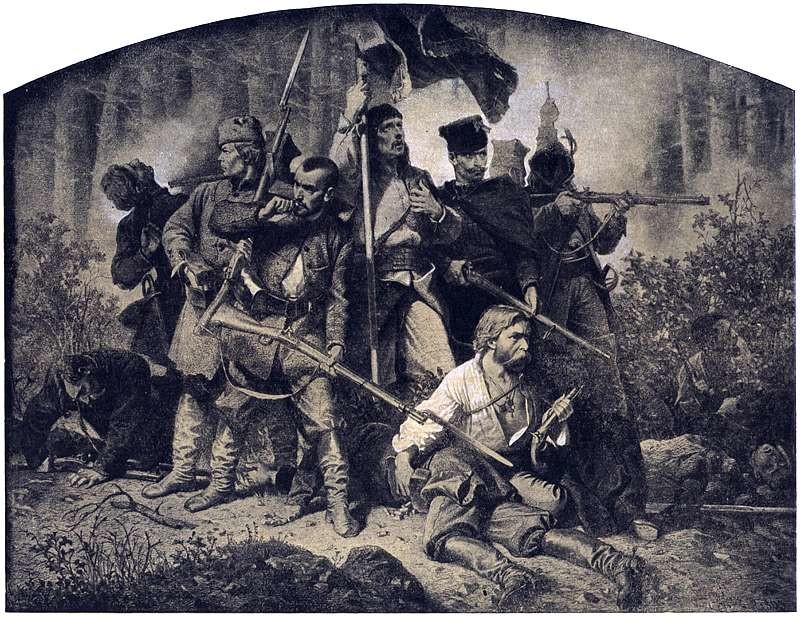
Unfortunately, during Jozef’s whole life , Poland was in turmoil and under the control of outside forces. An internal revolution was brewing, especially centered around the larger cities, but it made its way to the small city in which he lived. On January 24 1863, Henryk Gramowski with his small ten person band of insurgents, broke into the Russian cossack station in Jozefow, about 17 miles west of Tomaszow Lubelski. With the horses and guns they obtained and volunteers from nearby towns, they formed a poorly equipped 60 person troop.
This was part of a bigger battle
https://www.facebook.com/216532571884064/photos/a.225763764294278/790735797797069/
********** On the next day, January 25, 1863, after being widowed for two months, Jozef married Paulina Kurkieiwcz (my second great grandmother.) Often parents remarried quickly because of the care of young children but Jozef’s children were deceased and Paulina had never been married. While Jozef was of the Greek Uniate faith, his bride-to-be was from the Latin church and they married in the Latin church. Paulina’s parents were shoemakers in Tomaszow. Likely the furriers provided leather for the shoemakers so the families would have known each other. Unlike his first marriage, there was not a prenuptial agreement for this marriage. Marcin Halkiewicz who had been a declarant for the sad occasion of Katarzyna’s death, was there to help him celebrate the new marriage. Marcin was no longer a shoemaker but had become a farmer. Szymon Zolkiewski, another shoemaker, was a witness at both events also. (I haven’t figured out yet how he is related.) **********
Five days later on January 30, the Russians in Tomaszow Lubelski expected trouble so they sent their customs chamber money to Zamosc and locked up their 150 cossacks in their barracks with a few guards. Gramowski’s group attacked on January 31 at night and both sides suffered casualties. The Russians seemed to accept defeat and left for Żdanowie, 24 miles North near Zamosc, the next day on February 1. The small opposition group went into Tomaszow Lubelski and declared a Polish national government. The victory was short lived because on February 5, the Russians returned and the Bloody Day in Tomaszów Lubelski happened. Two loud cannon balls were the only warning. Doors and windows were broken and fires were started. The people living there left their houses attempting to save their belongings and were killed. Around 80 people died.
https://www.historiaregionu.org/powstanie-styczniowe-w-regionie?lang=pl
**********What was this unsuccessful January Insurrection (Uprising) that occurred from 1863 to 1864 that resulted in more control by Russia of Poland? During 123 years of partition, there were many attempts to restore Poland’s independence. Around 1860, Russia had been recently defeated in the Crimean War which had hurt them financially and politically. Resistance groups and demonstrations began to occur. There were two prevailing camps -- the “reds” and the “whites” though nothing was highly organized. The “reds” were made up of common people -- peasants and merchants -- who wanted more rights. The “whites” were led by Andrzej Zamoyjski, an intellectual who owned property and who favored a return to the pre-1830’s period before the constitution was created for the Kingdom of Poland. While this version of Poland was the smallest ever, with Russia dominating other areas, the constitution of this era promised freedom of speech and religious tolerance. It still favored the nobility and reduced some rights of peasants and Jews. Russians disregarded it and that contributed to unrest, leading in 1830 to a “November Uprising.” After that a more conservative statute was put into place but wasn’t implemented. **********
In February, 1861, demonstrators gathered in Warsaw to commemorate a 1831 battle. The Russians killed some of the protestors and implemented more repressive policies. Over the next year there were more demonstrations resulting in deaths and deportations to Siberia. By 1863, there were plans for a massive uprising. Trying to prevent this, forced conscriptions into the Russian Army happened January 14 and 15. Rather than reducing the coming opposition, they were inspired to begin earlier than planned on January 22. For the next year and a half, there were 2500 battles. The insurgents were small in number and poorly equipped, compared to the Russians. By April, 1864, 80,000 Polish people had been deported to Siberia which caused great fear. Hundreds of people were killed. Poland was to no longer exist -- institutions were abolished, the Polish language was not to be taught in the schools, and official positions were taken over by Russians. Many gentry lost their lands which also negatively affected the peasantry who already struggled. The rebellion was unsuccessful and resulted in more control of Poland by Russia. **********
While it is impossible to truly comprehend what this experience was like for Jozef and his family, it is true that they had five children from 1864 to 1871 who all lived less than a year until Katarzyna (my great grandmother) was born. She is the only one I have found from this family that survived to adulthood. While it is true that infant mortality was high in general, for comparison only a few of the eight children in Jozef’s family died before adulthood. So for some reason this family experienced a higher than normal infant mortality rate.
These experiences probably had a deep impact on Jozef and his family that would continue for generations.**********
https://www.inyourpocket.com/warsaw/the-january-uprising-1863-64_75398f (this one has some amazing pictures)
https://lublin.tvp.pl/41150235/rocznica-krwawego-dnia-w-tomaszowie-lubelskim
Historia Regionu Tomaszów Lubelski Bełz Rawa Ruska
Uprising in zamosc area https://www.historiaregionu.org/powstanie-styczniowe-w-regionie?lang=pl
https://www.historiaregionu.org/historie-z-regionu?lang=pl add about 2nd story about Lt. Grunseid
https://www.historiaregionu.org/tomaszw-lubelski?lang=pl image and story


 Jozef Wiszniowksi and Marianna Kaszucka married on February 3, 1849. Their Greek Catholic wedding is one of many examples of a combination of different families. They are both related to me through my 2x great grandmother Paulina Kurkiewicz. The husband, Josef is my 3x great uncle on Paulina’s maternal side. The wife, Marianna, is my 1rst cousin 4x removed on Paulina's father's side. They were not closely related.
Jozef was a 24 year old journeyman shoemaker who was literate and able to sign his own wedding record. His parents were deceased. Blazej had been a potter and then worked as a gravedigger. His mother was Agnieszka nee Szczesnicka.
Marianna, was a 17 year old, and her parents were Teodor Kaszucka and Teodorzia nee Panczyszak, local furriers. Their 33rd wedding anniversary was a week earlier.
Antoni Kurkiewicz (my 4th great grandfather), age 54 was a witness for Marianna Kaszucka (his niece) and Jozef Wisniowski's wedding. He was a shoemaker at the time. The other witness was Jan Reike?, a 34 year old weaver.


 Tomorrow is the anniversary of my grandfather’s parents’ wedding. The translated record starts out, “ It happened in town Tomaszów(Tomaszó...
 Most of the emigration from Poland occurred in the late 1800s to early 1900s but there was a small amount before then. The very first Po...
 The last name Dominik is derived from Latin and means “of the Lord.” Anna Kosciucha (Ania) from Legnica, Poland told me on August 23, 2...